What earthen construction knew before we measured it
After an earthquake, an engineer is naturally drawn toward what failed. Working in the High Atlas gradually taught me to ask another question.
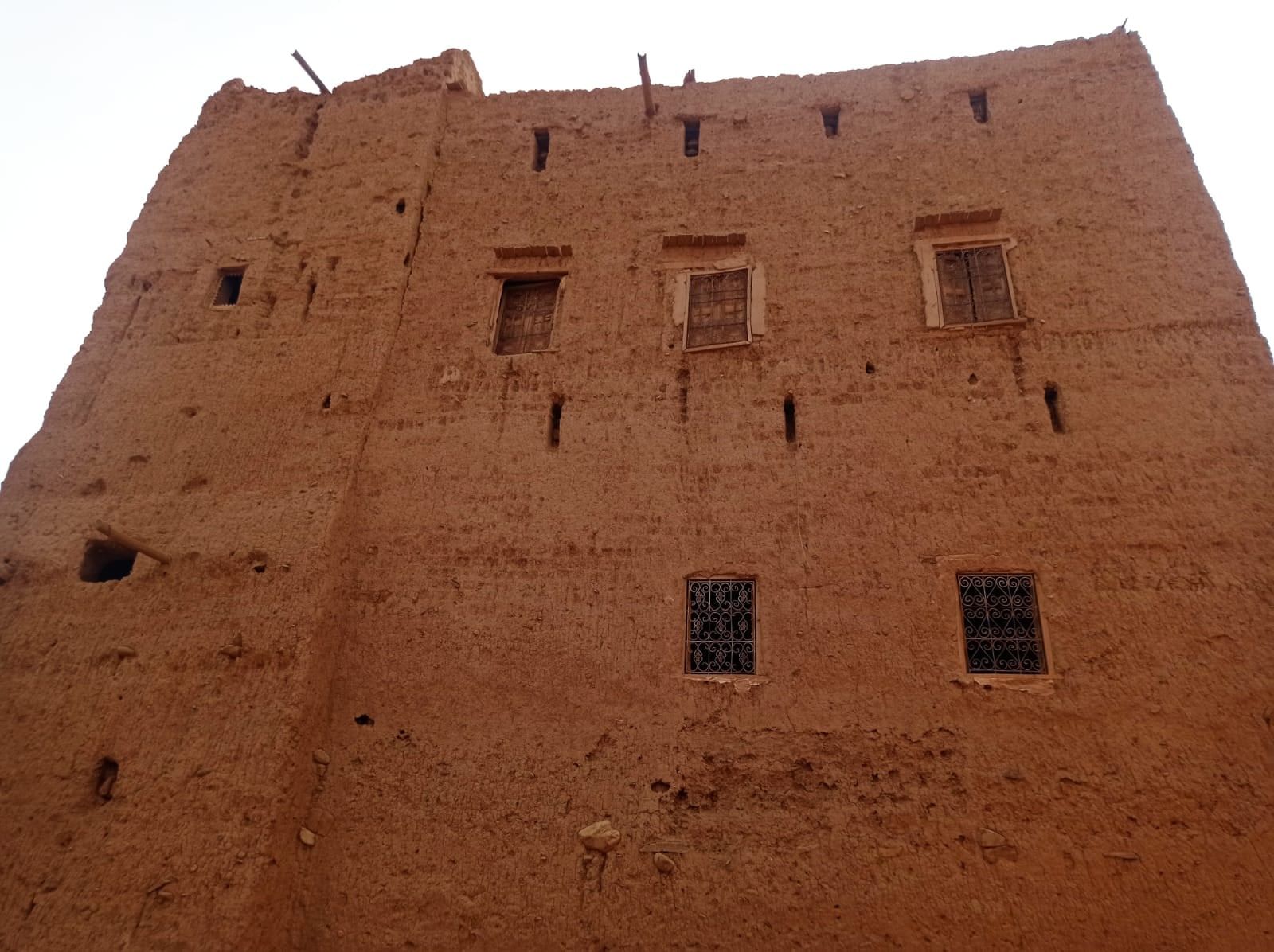
After an earthquake, an engineer is naturally drawn toward what failed.
We photograph cracks. We classify mechanisms. We measure displacements. We look for lost connections, unstable walls, failed diaphragms and portions of buildings that no longer follow the structural logic they were supposed to follow. It is necessary work. Before deciding how to repair something, we have to understand how it was damaged and why.
Working in the High Atlas after the Al Haouz earthquake, however, gradually taught me to ask another question.
What survived, and why?
It sounds obvious, but it changes the way you look at a building.
Many of the villages affected by the earthquake were built with materials that modern engineering tends to describe first by their limitations. Earth, stone, timber, irregular masonry. Materials without the uniform mechanical properties we are used to assigning to concrete or steel. Buildings constructed without structural drawings, calculation reports or numerical models. Walls whose thickness changes from one point to another, floors assembled according to local availability, connections that cannot always be described with a standard detail from a technical manual.
If you approach these buildings only through the language of contemporary engineering, the first impression can be uncomfortable. There are too many variables. Too many things that cannot be measured precisely. Too many details that do not fit neatly inside the categories we use every day.
The temptation is to look at them as incomplete versions of modern buildings.
I think that is a mistake.
Traditional buildings were not designed badly according to our rules. They were designed according to another process entirely.
That process did not begin with equations. It began with observation.
Someone built a wall in a certain way. It lasted.
Someone changed the proportions. Perhaps it did not.
A roof worked better when the timber elements were arranged in one direction rather than another. An opening too close to a corner created a weakness. A certain thickness gave stability. A certain material behaved better with another. A detail was repeated because generations had seen that it worked.
The knowledge was not written in a structural calculation, but that does not mean there was no knowledge.
It was stored in the building tradition itself.
When we arrived in places such as Tazarine and began looking carefully at traditional construction after the earthquake, this became impossible to ignore. The buildings were giving us information that could not be understood simply by saying that one material was weak and another was strong.
Damage was telling a story.
Sometimes the weakest part was exactly where engineering intuition suggested it would be. A loss of connection between perpendicular walls. A heavy roof pushing on a wall that could no longer work as a coherent box. A large opening interrupting the resistance of a facade. Poor maintenance reducing material quality over time.
In other cases, however, what mattered most was not the original construction but what had happened to it afterwards.
A building that had existed for generations had rarely remained exactly as it was first built.
Rooms had been added. Roofs had been replaced. Openings had been enlarged. New floors had been introduced. Concrete had sometimes been placed over materials that had never been intended to carry its weight. New portions had been attached to old ones without understanding how the two would move together during an earthquake.
This is one of the things that stayed with me most strongly.
Sometimes what had survived for a century was not what failed first.
What failed was what we added later.
There is a lesson in that which goes beyond any particular construction technique.
When engineers arrive after a disaster, we naturally bring solutions with us. We have standards, models, stronger materials and technologies that previous generations did not possess. All of those things are valuable. I would never argue that traditional construction should simply be left untouched because it is traditional. The Al Haouz earthquake showed too clearly what happens when vulnerable buildings meet a strong seismic event. People lost their homes and, much more importantly, people lost their lives.
There is nothing romantic about structural vulnerability.
But recognising vulnerability is not the same as assuming that everything old should be replaced by something new.
That distinction became increasingly important to me.
Before deciding how to strengthen a traditional building, we first have to understand what made it a building in the first place.
How do the walls interact?
What is the role of the timber?
How is the roof connected?
What happens at the corners?
Where does the mass sit?
How has the building changed during its life?
Which elements are original and which ones arrived later?
Where has water entered?
Which materials can deform together and which ones cannot?
Only after those questions begin to have answers does the intervention really start.
Modern engineering gives us powerful methods for doing this. We can measure material properties, identify possible collapse mechanisms, create numerical models and compare different strengthening strategies before touching the structure.
But measurement should not replace observation.
A number in a laboratory report tells us something about a material. It does not automatically tell us how a building made from that material has survived fifty, eighty or one hundred years.
The existing structure is itself a source of evidence.
Its cracks are evidence.
Its deformations are evidence.
Its repairs are evidence.
The parts that have remained intact are evidence too.
In engineering we often speak about experimental validation. We design a theory, test it and compare the result with reality. Existing buildings offer us another form of experiment, only one that has been running for decades.
Time has already been loading them.
Rain has already reached them.
Heat and cold have already changed them.
People have altered them, repaired them and lived inside them.
Then, in the High Atlas, an earthquake tested them in a way none of us would ever choose to reproduce at full scale.
When a structure survives all of this, I think it deserves our attention before it receives our judgement.
This does not mean that survival proves safety.
A building may have survived one earthquake and remain extremely vulnerable to the next. A wall may still be standing despite having exhausted much of its capacity. A construction tradition may contain very effective principles and, at the same time, details that are clearly dangerous under seismic loading.
Engineering exists precisely because experience alone is not enough.
But the opposite is also true.
Calculation alone is not enough either.
The most interesting work begins when the two meet.
In several of the activities I have been involved in after the earthquake, particularly when working with traditional masonry and earthen construction, this meeting between local knowledge and engineering knowledge has been essential.
A local builder may not describe the behaviour of a wall using the terminology of shear resistance, out of plane mechanisms or diaphragm action.
That does not mean he has no understanding of how the building works.
He may know that a particular timber element has always been placed at a certain level. He may know which soil produces a better mixture. He may recognise immediately that one wall has been altered in a way that is unusual for the local construction tradition. He may know that a particular detail was introduced only recently.
An engineer brings another kind of knowledge.
We can explain why some of those details work.
We can identify situations where tradition alone is insufficient.
We can calculate forces that cannot be estimated reliably through experience. We can design connections capable of providing continuity where the original system is weak. We can introduce reinforcement in a controlled way and evaluate how the intervention changes the global behaviour of the structure.
The most useful solution is often not found by choosing between those two worlds.
It is found by making them speak to each other.
This is also why I have become increasingly cautious about interventions that are impressive simply because they are technologically sophisticated.
There is a very human attraction to strong materials.
If an existing wall is weak, the instinct is to add something stronger.
Concrete is stronger than earth.
Steel is stronger than timber.
A rigid element feels safer than a flexible one.
But structures do not behave as collections of isolated material strengths. They behave as systems.
The strongest element in the building can create a problem if everything around it moves differently.
A strengthening intervention can move forces toward a part of the structure that was never expected to receive them. Increasing stiffness can reduce deformation in one location while increasing demand somewhere else. Adding weight can solve one problem and create another.
Compatibility matters.
Sometimes more than strength.
This is particularly visible in historic and traditional buildings, but I think it is one of the fundamental ideas of structural engineering in general.
The objective is not to make every part as strong as possible.
The objective is to make the whole system behave coherently.
That requires restraint.
It requires accepting that the most dramatic intervention is not necessarily the best one.
Sometimes the right decision is to reconnect two walls.
Sometimes it is to improve the behaviour of a floor.
Sometimes it is to repair a damaged portion using materials compatible with what already exists.
Sometimes it is to remove something that should never have been added.
And sometimes, of course, the existing building cannot reasonably be made safe and a much deeper intervention becomes necessary.
There is no ideological answer.
There is only the responsibility to understand the structure well enough to choose.
This experience has changed the way I think about the word progress.
We often imagine progress as addition.
More material.
More technology.
More strength.
More layers.
More control.
Engineering itself can encourage this way of thinking because our ability to intervene keeps increasing. We can calculate more, reinforce more and build things that would have been unimaginable only a few generations ago.
That is extraordinary.
But the ability to add something does not automatically mean that adding it is an improvement.
Sometimes progress is knowing what not to touch.
Sometimes it is understanding why something worked before trying to replace it.
Sometimes it is removing an intervention that was introduced with good intentions but without understanding the original system.
This idea has stayed with me far beyond the High Atlas.
The more projects I work on, the more I notice how often professional intelligence is associated with doing something visible.
A client expects a solution, so we feel that the solution must be an addition.
A structure has a problem, so we introduce another structure.
A process is inefficient, so we add another procedure.
A company has difficulties, so we create another layer of management.
Technology creates new possibilities, so we add another tool.
Sometimes that is exactly what is required.
Sometimes it is simply our discomfort with leaving something alone.
Old buildings are particularly good at exposing this instinct because they existed before us and, if we do our work properly, they may continue to exist long after us.
There is a certain humility in that.
As engineers we arrive for a very short moment in the life of a structure.
We inspect it.
We measure it.
We create a model.
We make decisions.
Then we leave.
The building continues.
That perspective makes me think differently about what an intervention should achieve.
We should not try to make an old structure prove that modern engineering is superior to the people who built it.
We should try to understand enough of its logic to make it safer without destroying the reasons it survived in the first place.
The distinction is subtle, but I think it matters.
It also changes the way we look at heritage.
Heritage is often discussed in terms of architectural appearance, cultural value and history. All of that is important. But there is also technical knowledge embedded in heritage.
A traditional building is a record of decisions.
Which materials were available.
How they were combined.
How spans were limited.
How openings were proportioned.
How builders responded to climate.
How structures were repaired with what the community could obtain locally.
Some of those decisions were excellent.
Some were not.
What matters is that we examine them before assuming that the absence of modern calculation meant the absence of intelligence.
One of the privileges of working in structural engineering is that the profession constantly forces you back toward reality.
You can have a beautiful theory, but eventually there is a wall in front of you.
You can have a sophisticated model, but eventually you have to explain why that crack exists.
You can have a code formula, but eventually you meet a building that does not behave exactly the way the simplified assumptions suggested.
Reality is not disrespecting the theory.
It is reminding us what the theory was created to describe.
The buildings of the High Atlas reminded me of this repeatedly.
They made me more interested in the space between calculation and observation.
Between modern engineering and accumulated experience.
Between what we can measure and what has already been tested simply by existing for a very long time.
I do not think the lesson is that the past knew better than us.
Nor do I think the lesson is that modern construction has somehow lost its way.
That would be too simple.
We build safer structures today because engineering has advanced enormously. We understand earthquakes better. We understand materials better. We can model behaviour that traditional builders could only discover through experience, sometimes at an unacceptable human cost.
The lesson, for me, is different.
Knowledge does not always arrive in the form we expect.
Sometimes it is an equation.
Sometimes it is a building detail repeated for generations.
Sometimes it is a numerical model.
Sometimes it is a wall that is still standing.
Our responsibility is to recognise the difference between tradition that deserves to be questioned and experience that deserves to be understood.
That is not always easy.
It requires us to arrive with tools but without assuming that the tools already contain the answer.
It requires us to measure without believing that everything valuable can be reduced to a measurement.
It requires us to improve things without automatically assuming that improvement means replacing them.
Perhaps this is one of the reasons traditional construction continues to interest me so much.
It reminds me that engineering is not only the science of making things stand.
It is also the discipline of understanding why they do.
And every now and then, an old wall can teach us something before we have even opened the model.
We spend a lot of time trying to improve what time has already learned to preserve.
The challenge is knowing when it really needs our help.